
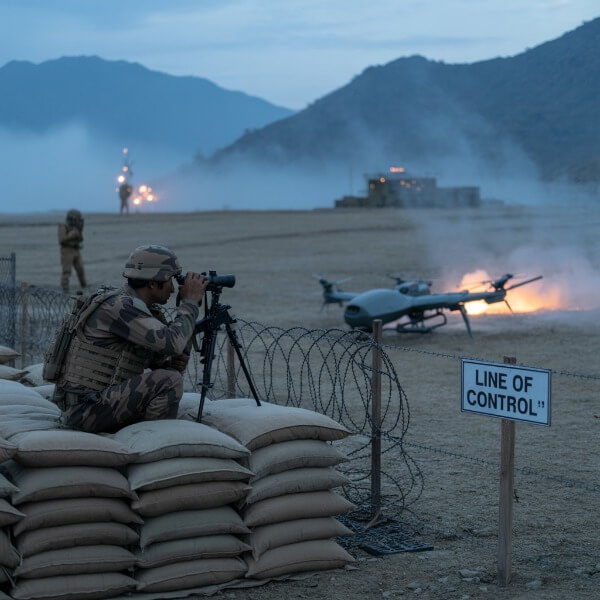
The already volatile relationship between India and Pakistan took a dramatic turn in late April 2025, when a deadly terrorist attack in the scenic Kashmir valley set off a chain reaction of military strikes, drone warfare, and threats of nuclear escalation. What began as yet another tragic episode in the long-running Kashmir conflict quickly spiraled into the most serious confrontation between the two nuclear-armed neighbors in decades.
The international community watched with growing alarm as missiles flew across the border, drones targeted military installations, and both nations mobilized troops along the contested Line of Control (LoC). By the time a fragile ceasefire was brokered on May 10, at least 80 people had been killed, including civilians caught in the crossfire.
This latest crisis underscores how quickly tensions between India and Pakistan can explode—and how difficult it is to put the genie back in the bottle once the shooting starts.
The Spark: A Deadly Attack in Pahalgam
The immediate trigger came on April 22, when gunmen opened fire on a group of tourists in Pahalgam, a popular resort town in Indian-administered Kashmir. The attack left 26 dead, most of them Hindu pilgrims from other parts of India.
A little-known militant group, The Resistance Front (TRF), claimed responsibility. But Indian officials immediately pointed the finger at Pakistan, accusing its intelligence agencies of backing the militants—a charge Islamabad vehemently denied.
Indian Prime Minister Narendra Modi vowed a strong response, declaring, “Those behind this barbarity will not go unpunished.”
Operation Sindoor: India’s Retaliation
Fifteen days later, on May 7, India made good on its threat. In a pre-dawn operation codenamed “Operation Sindoor,” Indian forces launched 24 precision missile strikes deep into Pakistani territory, targeting what New Delhi described as terrorist training camps in Punjab and Pakistan-administered Kashmir.
This marked a significant escalation—India had not struck inside Pakistan’s Punjab province since the 1971 war. Among the targets were facilities linked to Lashkar-e-Taiba (LeT) and Jaish-e-Mohammed (JeM), two Pakistan-based militant groups India blames for multiple attacks on its soil.
Pakistan’s military claimed the strikes killed 31 civilians, including children, and denied any militant infrastructure was hit. Meanwhile, Islamabad scrambled fighter jets and shot down at least two Indian aircraft, according to Pakistani officials—a claim India neither confirmed nor denied.
Pakistan’s Counterattack and the Drone War
Pakistan’s response was swift. Within hours, it launched drone and missile strikes across the LoC, hitting Indian military bases in Punjab, Rajasthan, and Gujarat. For the first time, air raid sirens blared in major Indian cities near the border, sparking panic.
The following days saw a tit-for-tat drone war, with both sides targeting radar installations and air defense systems. India struck near Rawalpindi, home to Pakistan’s army headquarters, while Pakistani drones penetrated deep into Indian airspace.
The conflict reached its peak on May 9-10, when:
- India bombed Pakistani air bases, including one just 35 km from Karachi.
- Pakistan retaliated with missile strikes on Indian airfields in Udhampur, Pathankot, and Bhuj.
Civilian casualties mounted, with both sides accusing the other of hitting residential areas.
The Nuclear Shadow
As the fighting intensified, fears grew that the conflict could spiral out of control. Pakistan’s Defense Minister Khawaja Asif warned that any attempt by India to divert river waters—after New Delhi suspended the Indus Waters Treaty—would be considered an “act of war” and could trigger a nuclear response.
Meanwhile, India’s Defense Minister Rajnath Singh declared that “Pakistan’s terrorism will no longer be tolerated,” signaling a shift toward preemptive strikes on militant bases across the border.
Ceasefire: A Fragile Truce
Under intense international pressure, the two sides agreed to a U.S.-brokered ceasefire on May 10. But the truce remains shaky.
- India’s PM Modi called it only a “pause,” not a resolution.
- Pakistan’s military hailed it as a victory, claiming it had successfully defended its sovereignty.
Behind the scenes, diplomats scrambled to prevent another flare-up. The U.S., U.K., and Saudi Arabia pushed for backchannel talks, while the U.N. Security Council held emergency meetings.
Why This Conflict Is Different
Unlike past skirmishes confined to Kashmir, this confrontation saw:
- Deep Strikes: India hit targets deep inside Pakistan’s Punjab, a strategic shift.
- Drone Warfare: Both sides deployed drones extensively, a new frontier in their conflicts.
- Economic Warfare: India’s suspension of the Indus Waters Treaty could devastate Pakistan’s agriculture.
- Global Alarm: The risk of nuclear escalation drew unprecedented international intervention.
What Happens Next?
Analysts warn that without a lasting political solution, another major clash is inevitable. Key flashpoints to watch:
- Kashmir’s Status: India’s 2019 revocation of the region’s autonomy remains a sore point.
- Militant Activity: If another major attack occurs, India may strike even harder.
- Water Dispute: The Indus Treaty suspension could become a permanent rupture.
For now, the guns have fallen silent. But as history shows, between India and Pakistan, peace is always temporary.
 nofilter.news
Leave a comment