
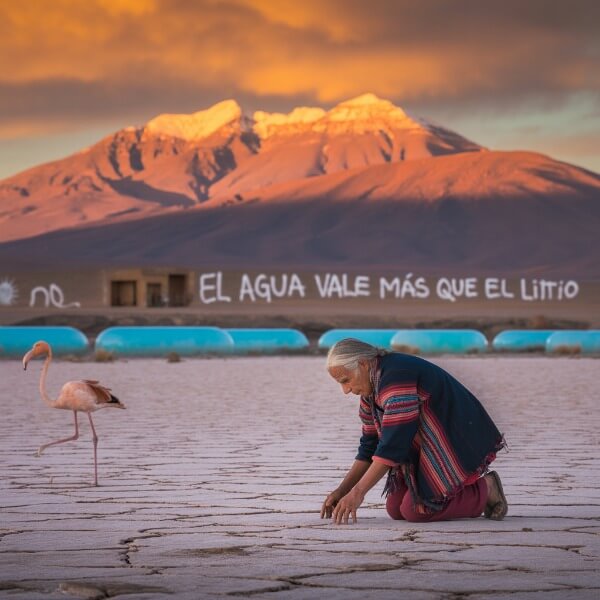
Deep beneath the salt-crusted surface of Chile’s Atacama Desert lies a treasure more valuable than oil, more coveted than gold—lithium, the irreplaceable mineral powering the world’s clean energy revolution.
In April 2023, Chile’s government made a move that sent shockwaves through global markets: it announced the nationalization of its lithium industry, putting the state in control of the world’s largest and purest lithium reserves. The goal? To ensure that Chile, not foreign corporations, reaps the profits of its own natural wealth.
But this decision has ignited a high-stakes battle—one that pits economic ambition against environmental disaster, indigenous rights against industrial progress, and geopolitical superpowers against a small South American nation daring to defy them.
This is the untold story of Chile’s lithium gamble—and how it could make or break the future of green energy.
Why Lithium? The “White Gold” Fueling the Green Revolution
Lithium is the hidden backbone of the 21st-century economy. Without it, there are no:
- Electric vehicles (EVs) – Every Tesla, BYD, and Ford Lightning depends on lithium-ion batteries.
- Smartphones & laptops – Apple, Samsung, and every tech giant rely on lithium for their devices.
- Renewable energy storage – Solar and wind power need massive lithium batteries to function at scale.
The International Energy Agency (IEA) predicts that by 2040, global lithium demand could surge by 40 times—a staggering increase that has turned this unassuming metal into the most strategic resource on Earth.
And Chile holds the keys to the kingdom.
Chile’s Lithium Empire: The Atacama Desert’s Liquid Gold
Chile is home to the Atacama Salt Flat (Salar de Atacama), the Saudi Arabia of lithium, where the world’s purest and most easily extractable lithium brine flows beneath the cracked earth.
Key Facts About Chile’s Lithium Dominance:
- 2nd largest global producer (after Australia)
- Largest lithium reserves (9.3 million metric tons)
- 30% of global lithium supply comes from Chile
- Atacama’s lithium is 5x more concentrated than Argentina’s or Bolivia’s, making it far cheaper to extract
But Chile isn’t content with just mining raw lithium—it wants to control the entire supply chain, from extraction to battery production.
And that’s where the nationalization bombshell comes in.
Chile’s Lithium Nationalization: A Bold Power Play—Or a Dangerous Gamble?
In April 2023, Chile’s leftist president, Gabriel Boric, stunned the world by announcing a state-controlled lithium industry. The plan includes:
- A new national lithium company to oversee all mining operations
- Public-private partnerships, but with the state holding majority control
- Stricter environmental rules to protect water supplies
- Higher royalties to fund social programs
The message was clear: Chile will no longer let foreign corporations profit from its resources without giving back.
The Global Backlash: Who Wins and Who Loses?
1. The Mining Giants: SQM & Albemarle Under Fire
Two companies—SQM (backed by China) and Albemarle (U.S.-based)—currently dominate Chile’s lithium production. Now, they’re being forced to renegotiate contracts under far less favorable terms.
- SQM’s stock plunged 18% after the announcement.
- Albemarle is threatening to shift investments to Australia and Argentina.
2. China’s Silent Panic
China controls over 60% of global lithium refining, and its companies have been aggressively buying stakes in South American mines. Chile’s move could disrupt Beijing’s supply chain dominance, forcing Chinese EV makers like BYD and CATL to seek alternatives.
3. The U.S. and Europe’s Dilemma
The West desperately needs lithium for its own green energy push. But Chile’s nationalization means:
- Higher prices for Tesla, Ford, and Volkswagen
- Potential supply shortages if production slows
The U.S. is walking a tightrope—supporting Chile’s sovereignty while quietly pressuring for stable lithium flows.
The Hidden Crisis: Water, Indigenous Rights, and Environmental Collapse
While the world debates profits and supply chains, a humanitarian and ecological disaster is unfolding in the Atacama Desert.
1. The Water Crisis: Mining’s Deadly Thirst
Lithium extraction is water-intensive—it takes 500,000 liters of water to produce one ton of lithium. In the driest desert on Earth, this is catastrophic.
- Underground aquifers are vanishing, leaving indigenous farmers without water.
- Flamingo populations have dropped 40% due to shrinking lagoons.
- Locals accuse miners of “stealing their future.”
2. Indigenous Rebellion: “Our Land Is Not for Sale”
The Atacameño and Colla peoples, who have lived here for millennia, are fighting back:
- Protests and roadblocks have halted mining operations.
- Lawsuits under ILO Convention 169 (protecting indigenous rights) are piling up.
- “They call this green energy, but for us, it’s destruction,” says a community leader.
3. Can Technology Fix the Damage?
Chile is betting on Direct Lithium Extraction (DLE), a new method that could:
- Cut water use by 30-50%
- Speed up production (no more 18-month evaporation ponds)
But DLE is untested at scale, and critics warn it could still disrupt fragile ecosystems.
The Geopolitical Fallout: A New Era of Resource Nationalism?
Chile’s move is part of a broader trend:
- Mexico nationalized its lithium in 2022.
- Bolivia and Argentina are tightening control over their reserves.
- Zimbabwe banned raw lithium exports, demanding local processing.
The message? The Global South is done being exploited.
But this shift comes with risks:
- Investor flight – Mining companies may abandon Chile for “safer” countries like Australia.
- Supply chain chaos – If lithium becomes politicized, the EV revolution could stall.
- A new Cold War? – China, the U.S., and Europe are all scrambling to secure lithium, and Chile is now ground zero in this battle.
What Happens Next? Three Possible Futures
1. Chile Wins Big (The Best-Case Scenario)
- The state successfully manages lithium wealth, funding schools, hospitals, and green energy projects.
- New DLE tech minimizes environmental damage, making mining sustainable.
- Chile becomes a global hub for battery production, not just raw lithium.
2. Chaos & Conflict (The Worst-Case Scenario)
- Indigenous protests escalate, leading to violent clashes.
- Foreign investors pull out, crashing Chile’s economy.
- Lithium shortages trigger an EV industry crisis, delaying the green transition.
3. A Compromise (The Most Likely Outcome?)
- Chile softens its stance, allowing private firms more leeway.
- Indigenous groups win concessions, gaining royalties and land protections.
- The world adapts, finding new lithium sources while Chile remains a key player.
Conclusion: The World Can’t Go Green Without Chile—But at What Cost?
Chile’s lithium revolution is more than a mining dispute—it’s a test of whether the green energy future will be fair or exploitative, sustainable or destructive.
- Will Chile’s gamble pay off?
- Will indigenous voices be heard?
- Will the global lithium war spiral out of control?
One thing is certain: The battle for lithium will define the next decade. And the world is watching.
 nofilter.news
Leave a comment