
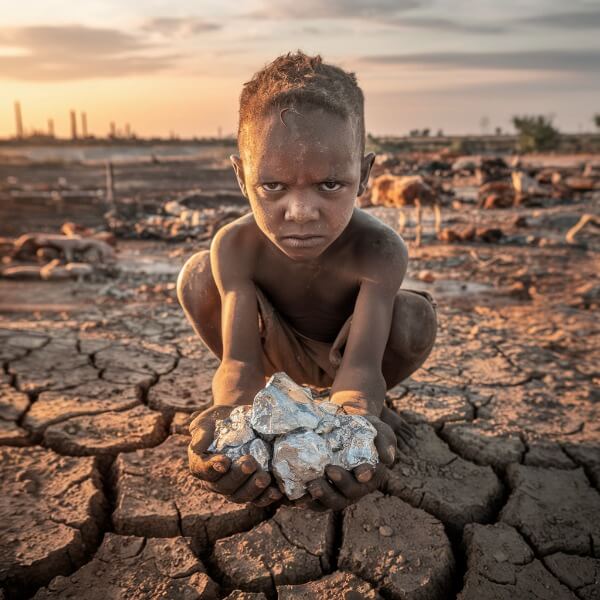
WINDHOEK, Namibia – The world is racing toward a green energy future, but for the people of the Namibian desert, this revolution looks eerily familiar. Foreign corporations backed by Western governments and Chinese investors are carving up ancestral lands, uprooting communities, and leaving environmental devastation in their wake—all in the name of saving the planet.
This isn’t just mining. This is Green Colonialism.
A Lithium Fever Dream – And A Nightmare for Locals
Beneath the vast, arid plains of southern Africa lies one of the world’s richest deposits of lithium—the so-called “white gold” powering electric vehicles (EVs) and renewable energy storage. Global demand is expected to increase tenfold by 2030, and corporations are scrambling to stake their claim.
But the rush for “clean” energy minerals has turned into a human rights catastrophe:
- In Uis, Namibia, a once-quiet farming community, bulldozers now tear through the earth as a European-backed lithium mine expands. Over 200 families have been forcibly evicted, many with less than a month’s notice. Compensation? A paltry $300 per household—barely enough to relocate, let alone survive.
- In Manono, Democratic Republic of Congo, where 70% of the world’s cobalt is mined, children as young as six sift through toxic sludge in makeshift pits, earning less than $2 a day to extract minerals for Tesla and Apple batteries.
- In Bikita, Zimbabwe, a Chinese-owned lithium operation has contaminated the local water supply, leaving villagers to walk miles for drinkable water while tankers drain aquifers to feed the mines.
“They call it green energy, but for us, it’s just another theft.”
says Miriam Kaunda, a displaced farmer in Namibia.
“First they took our diamonds, now our lithium. When will Africa’s wealth belong to Africans?”
The Hypocrisy of “Sustainable” Mining
Mining giants and Western governments tout these projects as ethical and climate-friendly. But the reality is starkly different:
- Land Grabs Under the Guise of Progress: In Zimbabwe, the government has seized over 50,000 hectares of land for lithium mining, often without consulting local communities. Many were only informed when trucks and excavators arrived.
- Broken Promises of Prosperity: Companies pledge jobs, but most skilled positions go to foreign workers. In Congo, less than 10% of mining revenue stays in the country, while 80% of locals live in poverty.
- Ecocide in the Name of Ecology: Lithium extraction requires 500,000 gallons of water per ton—a devastating toll in drought-stricken regions. In Namibia’s Khorixas district, rivers have run dry, killing livestock and crops.
“This isn’t sustainability—it’s resource plunder with a PR campaign,”
says Dr. Geoffrey Moyo, a Zimbabwean environmental scientist.
“The Global North wants to cut emissions, but they’re outsourcing the destruction to Africa.”
Why the World Isn’t Paying Attention
The silence around this crisis is by design:
- Corporate Greenwashing: Mining firms pour millions into “sustainability” branding, sponsoring climate conferences while suppressing reports on abuses.
- Western Media Blind Spot: Stories about oil corruption in Africa get coverage, but lithium exploitation doesn’t fit the “green hero” narrative.
- Government Complicity: The EU and US are desperate for lithium independence from China, turning a blind eye to human rights violations.
Resistance Rising – But Will Anyone Listen?
Across the continent, a rebellion is brewing:
- In Namibia, protesters have blocked roads to mining sites, demanding fair compensation.
- In Congo, activists are suing multinational firms for illegal land seizures.
- In Zimbabwe, villagers are sabotaging equipment to halt operations.
But without international pressure, their fight remains a whisper in the wind.
“We are not against green energy. We are against green energy built on our graves.””
says Congolese lawyer Jean-Baptiste Kasekwa.
The Uncomfortable Truth
The green energy revolution was supposed to be a beacon of hope. Instead, for millions of Africans, it’s become the latest chapter in a long history of exploitation.
If the world truly wants a just transition, it must answer one question:
Can we save the planet without sacrificing its people?
Demand accountability.
Share This Story.
 nofilter.news
Leave a comment