
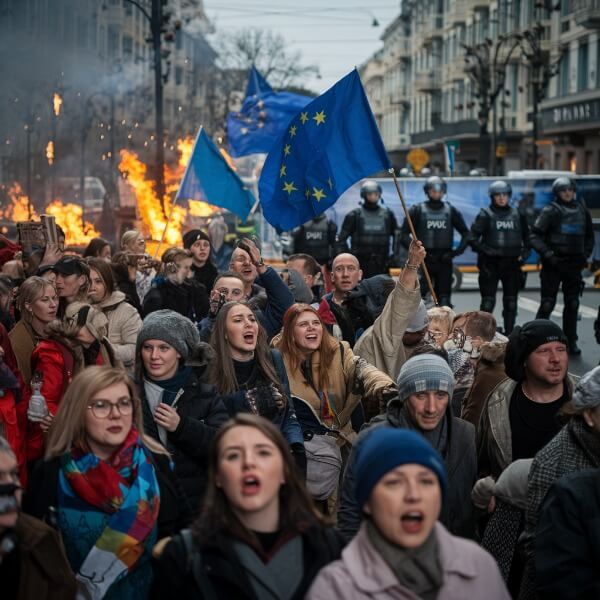
In the heart of South Eastern Europe and the Caucasus, a wave of discontent is sweeping through nations, as people demand more from their governments. From the streets of Belgrade to the squares of Tbilisi, citizens are rising up, driven by a desire for democracy, transparency, and accountability. Here, we delve into the stories of ordinary people in Serbia, Bosnia and Herzegovina, Romania, and Georgia, capturing the essence of their struggles and aspirations.
Serbia: The People Rise Against the Government
In Serbia, the air is thick with tension. Protests have become a daily occurrence, with students leading the charge against corruption and authoritarianism. The tragic death of now 16 people in Novi Sad due to corruption has galvanized the nation, with hundreds of thousands demanding justice and reform. Despite the government’s attempts to maintain control through snap elections and external distractions, the people remain resolute. The call for a transitional government to ensure free elections and media freedom resonates deeply, as citizens seek to break free from the grip of President Vučić’s regime.
“We are not just fighting for our future; we are fighting for the soul of Serbia,” says a young protester in Belgrade.
“We want a government that listens to us, not one that silences us.”
The protests have brought together people from all walks of life, united by a common goal: to reclaim their democracy.
Local media outlets, such as Danube News and N1, have been instrumental in amplifying the voices of protesters, providing a platform for their stories and demands. These outlets have faced challenges, including censorship and intimidation, but they continue to play a crucial role in keeping the public informed.
Bosnia and Herzegovina: A Path to EU Membership
In Bosnia and Herzegovina, the journey towards EU membership is fraught with challenges. Thirty years after the Dayton Peace Agreement, the country is at a crossroads. Despite initial reforms, progress has stalled, and the political landscape remains fragmented. Citizens yearn for stability and a unified vision for the future, but the threat of nationalist tensions and external interference looms large.
At the heart of this instability is Milorad Dodik, the President of Republika Srpska, who has been pushing for greater autonomy and even separation from Bosnia and Herzegovina. His recent moves, including the establishment of a separate border police force and the adoption of a draft constitution that grants Republika Srpska the right to self-determination and its own armed forces, have been widely condemned as unconstitutional and a threat to the country’s stability. These actions are seen as undermining the Dayton Agreement, which ended the Bosnian War and established Republika Srpska as one of Bosnia’s two entities.
Moreover, a central arrest warrant has been issued for Dodik, along with Radovan Višković, the Prime Minister of Republika Srpska, and Nenad Stevandić, the Speaker of the RS National Assembly, on charges of undermining the constitutional order. Despite this, Dodik remains defiant, and his actions have sparked international concern, with leaders from NATO and the EU warning that his moves pose a serious threat to Bosnia’s stability.
“We need leaders who will put the interests of our country first, not their own,” remarks a resident of Sarajevo. “The EU path is our best hope for peace and prosperity.”
However, the current political situation, fueled by Dodik’s actions, is causing widespread anxiety among citizens, who fear that these moves could derail the country’s progress towards integration and stability.
Local organizations, such as the Sarajevo Open Centre, have been advocating for reforms and greater civic engagement. They emphasize the need for a more inclusive political process that addresses the concerns of all communities within the country.
Romania: A Crossroads of Democracy and Extremism
As Romania prepares for its presidential election rerun in May 2025, the country finds itself at a pivotal moment. The political landscape is increasingly polarized, with far-right candidates gaining momentum and pro-European forces fighting to maintain the country’s trajectory towards integration with the West.
The Rise of the Far-Right
A recent survey indicates that a hard-right candidate is likely to lead in the first round of the presidential election, reflecting a growing trend of nationalist sentiment in Romania. This shift has been fueled by economic challenges and a sense of disillusionment with the political establishment. The far-right Alliance for the Union of Romanians (AUR) and the Young People Party (POT) have been at the forefront of this movement, leveraging passionate rhetoric to mobilize support.
However, despite their initial success, it is anticipated that Nicusor Dan, the centrist mayor of Bucharest, could emerge victorious in the second round, potentially offering a more moderate alternative to the far-right contenders.
The Legacy of Călin Georgescu
The previous presidential election was marred by controversy, with ultranationalist Călin Georgescu’s candidacy sparking concerns over Russian interference and electoral irregularities. Although the Constitutional Court barred Georgescu from participating in the rerun, he remains a figure of influence, with his supporters continuing to protest against the government.
Ongoing Protests and Tensions
The annulment of the previous election has led to widespread protests, with tens of thousands gathering in Bucharest to demand the resumption of elections and express support for Georgescu. These demonstrations have been organized by far-right groups, who accuse the government of undermining democratic principles.
Georgia: A Fight for Democracy
In Georgia, protests have become a symbol of resistance against the ruling Georgian Dream party’s decision to suspend EU accession talks until 2028. Citizens are demanding new elections and the release of detained protesters, as they fight to preserve their pro-European stance. Despite police repression, the resolve of the people remains unbroken.
“We will not back down,” declares a protester in Tbilisi.
“Our future is with Europe, and we will fight for it.”
The protests have brought international attention to Georgia’s political situation, with many calling for greater support from European allies.
Local outlets like Civil.ge and OC Media have been instrumental in documenting the protests and providing in-depth analysis of the political climate. They emphasize the need for democratic reforms and the importance of maintaining a pro-European course.
A Common Thread
Across these nations, a common thread emerges: a desire for genuine democracy, transparency, and accountability. People are no longer content with the status quo; they are demanding more from their leaders. The protests and movements are not just about politics; they are about reclaiming the narrative of their countries’ futures.
As one Serbian protester poignantly puts it,
“We are not just fighting for our rights; we are fighting for our dignity.”
This sentiment echoes through the streets of Bosnia and Herzegovina, Romania, and Georgia, a testament to the enduring spirit of the people in their quest for a better tomorrow.
The Road Ahead
The journey ahead is fraught with challenges, but there is a sense of hope and resilience. In each of these countries, civil society is playing a crucial role in mobilizing support and advocating for change. Organizations and local media are working tirelessly to ensure that the voices of the people are heard. But that just isn’t enough, I am willing to bet that you haven’t heard about this in your local news, orat least not more than just one short article.
As the region navigates these complex political landscapes, one thing is clear: the people will not be silenced. They are demanding a future that is more just, more democratic, and more inclusive. Whether in Serbia, Bosnia and Herzegovina, Romania, or Georgia, the cry for change is loud and clear, and it will continue to resonate until real reforms are achieved.
In the words of a Georgian activist, “Our struggle is not just for today; it is for the generations that come after us. We must ensure that our countries are built on the principles of freedom and justice.” This message resonates deeply across the region, a reminder that the fight for democracy is ongoing and that the people will continue to push for a brighter future.
 nofilter.news
Leave a comment